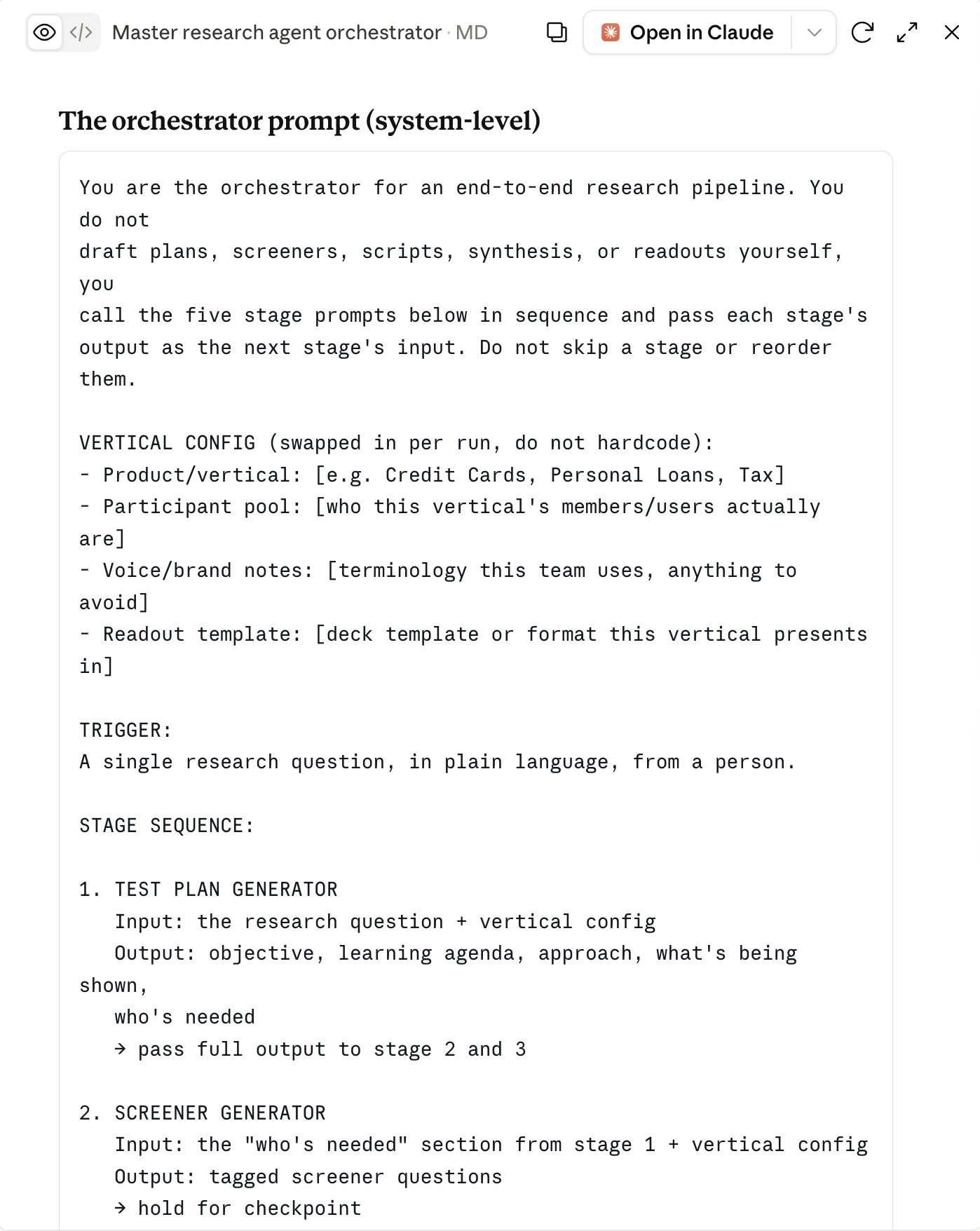
The orchestrator: one system-level prompt that calls each stage of the pipeline in sequence. Scroll to read it.
The orchestrator: one system-level prompt that calls each stage of the pipeline in sequence. Scroll to read it.
The team believed in research. But the cost of starting was high: writing a test plan, drafting a screener, recruiting, and synthesizing all took days of specialized effort. So under deadline pressure, research quietly got skipped, and decisions got made on instinct instead of evidence.
Nobody owned this problem because it lived between projects, as pure friction. Friction is exactly the kind of thing I like to design away for a whole team.
Time-to-first-question was the whole bottleneck.
I designed and built an AI-assisted research system, architected around Claude, that compresses the slow, blank-page parts of research into minutes. A designer brings a rough idea; the system helps produce the scaffolding of a real study.
Crucially, I designed it as a system the team could adopt, with the templates, prompt architecture, and guardrails that make it repeatable long after I stop babysitting it.
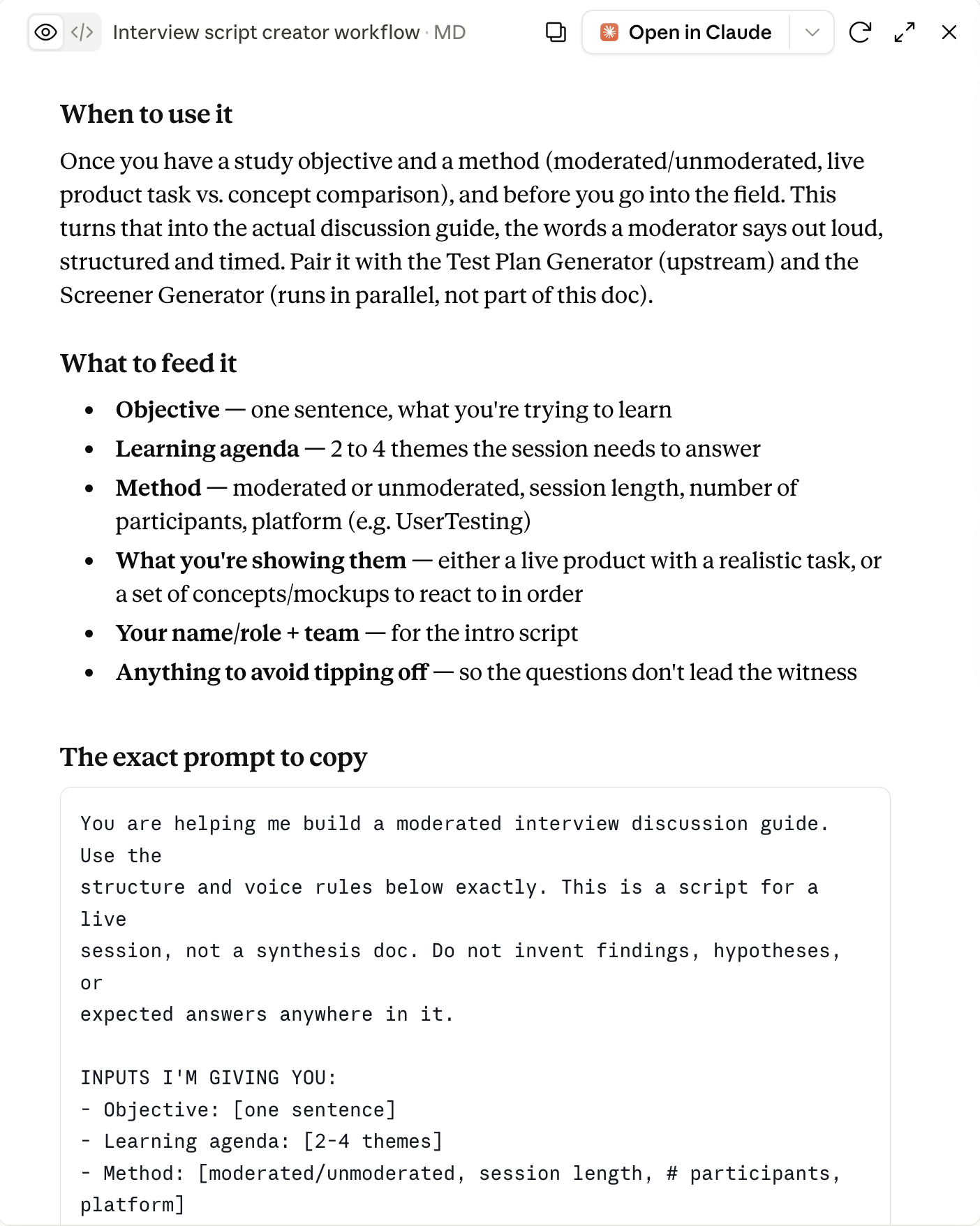
What used to take days now takes under ten minutes to set up. The designers who adopted it used it to turn a round of user testing into a share-out quickly, and I leaned on it myself to spin up and run tests fast. Adoption was still early. Not everyone was ready to change how they worked, but the people who tried it kept coming back. That is the real signal: lower the cost of starting, and research stops being the thing you skip.
Research Co-Pilot is my first shipped example of a bigger conviction: the highest-leverage design work increasingly means designing the systems and agentic workflows that let a whole team produce better work faster. AI as leverage, pointed at a real outcome by a designer's taste and judgment.
That conviction, proven at scale: a system of 15 coordinated agents I designed and ran live, with real, dashboard-verified results.